
Artificial Light at Night is Not Just About Stars
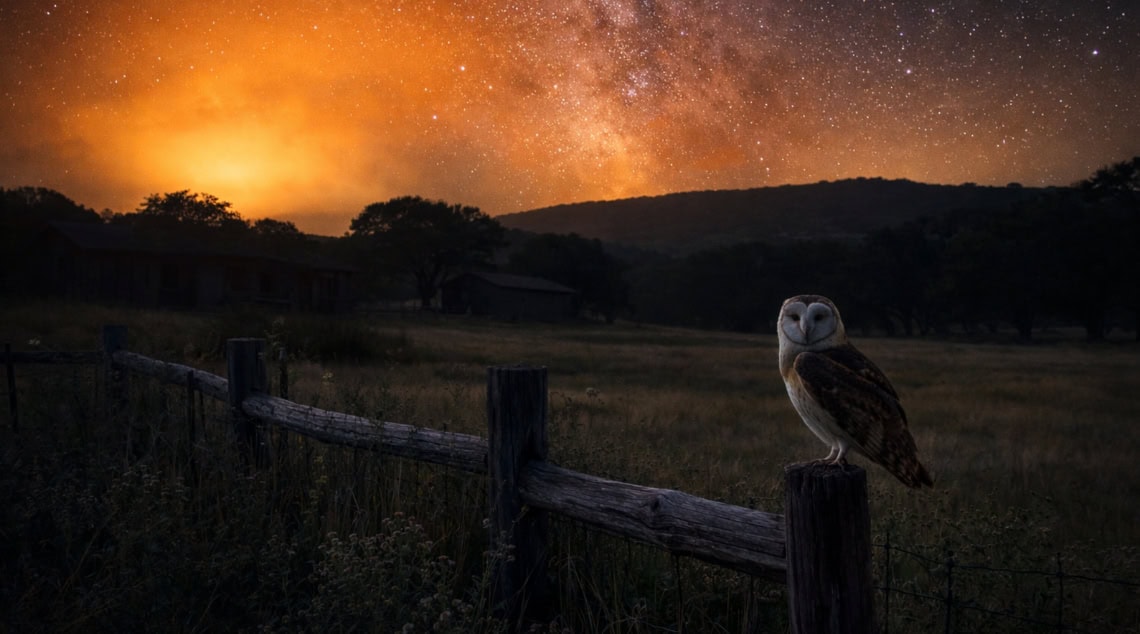
Picture a Texas night decades ago: stars scattered across an ink-black sky, nightjars calling through the darkness, and owls gliding silently between trees. For centuries, nocturnal birds relied on the predictable rhythm of day and night to navigate, hunt, nest, and migrate. But today, that darkness is vanishing.
We refer to this phenomenon as Artificial Light at Night, or ALAN. While many recognize light pollution as a threat to stargazing, fewer understand its profound impact on creatures that depend on darkness for survival. Today, we focus on nocturnal birds struggling to adapt to our illuminated world.
What is ALAN?
Artificial Light at Night refers to any human-made light that brightens the outdoor environment after sunset. This includes streetlights, building illumination, sports field lighting, parking lot lamps, and even the glow from our homes. When this light scatters through the atmosphere, it creates a dome of brightness known as “skyglow”, which can extend far beyond city limits, reaching into rural areas and natural habitats.
The numbers tell a troubling story. Between 2012 and 2016, the area of Earth covered by artificially lit surfaces increased by approximately 2% each year. Citizen science observations reveal an even starker reality: between 2011 and 2022, night sky brightness increased by roughly 10% annually. Over 99% of Americans and 80% of the world’s population now live under light-polluted skies.
For Texas, this means that skyglow from major metropolitan areas, such as Dallas-Fort Worth, Houston, San Antonio, and Austin, now spreads across the landscape, affecting ecosystems dozens of miles away. In addition, even a single unobstructed area light, when directed horizontally or into the sky, can spread light for miles.
ALAN’s Effects on Nocturnal Birds
The impacts of artificial light on nocturnal birds range from disrupting individual behavior to threatening entire populations.
Reduced Nesting Success
A study of western barn owls and tawny owls found that nest box occupancy was significantly lower in illuminated church towers compared to unilluminated ones. While reproductive output remained unchanged, ALAN reduces the availability of safe nesting sites, forcing birds to compete for increasingly scarce dark spaces.
Disrupted Navigation & Migration
Many bird species navigate using celestial cues like the moon and stars. Artificial light throws this ancient system into chaos: birds drawn into lights often become entrapped, circling lit areas in a disorienting trance, or collide against buildings. Tall buildings with bird deaths get significant attention. However, a large portion of the deaths due to building collisions occur on one and two story buildings.
On foggy nights, skyglow reflecting off lights becomes particularly disorienting, as birds can’t locate any clear ‘source’ to follow. Multiple mass-mortality events have been documented on foggy nights during the bird migration season.
Interference with Feeding Patterns
ALAN disrupts the delicate balance between nocturnal hunters and their prey. Artificial light alters insect behavior, drawing some species toward it while repelling others. For specialized feeders like nightjars and owls, these disruptions make prey less available in their preferred hunting grounds. Over the season, the continuous lack of food lessens their chances of survival.
Physiological Stress & Hormonal Imbalance
Research across multiple bird species demonstrates that ALAN disrupts birds’ circadian rhythms, altering brain gene expression and affecting sleep patterns, metabolism, and seasonal reproduction.
A study by the UT Southwestern Medical Center has documented reduced neurogenesis, altered hippocampal function, and changes in dopamine signaling in birds exposed to artificial light. Birds show arrhythmic activity patterns, nighttime restlessness, and suppressed nocturnal melatonin levels. For migratory species, ALAN can interfere with the precise seasonal timing required for successful breeding.
Why ALAN Matters in Texas
Texas holds special significance in the story of bird migration. The state lies along the Central Flyway, one of four major North American migration routes used by millions of birds traveling between breeding grounds in the north and wintering areas in Central and South America. Our diverse landscapes range from coastal wetlands to desert grasslands and pine forests, and they provide critical stopover habitats where exhausted migrants rest and refuel.
ALAN threatens this vital corridor. Texas is home to some of the nation’s fastest-growing metropolitan areas, each surrounded by an expanding halo of skyglow. Meanwhile, rural areas face increasing light intrusion from oil and gas operations, agricultural facilities, and roadway expansion.
The stakes are particularly high for species that depend on Texas year-round, such as barn owls or screech owls. Meanwhile, millions of migrating birds pass through the state twice each year, relying on Texas’s darkness to navigate safely and find the food they need to complete their journeys.
Solutions Based on the 5 Principles
Protecting nocturnal birds from ALAN doesn’t require returning to a pre-electric age. Instead, it demands thoughtful lighting practices guided by five principles for responsible outdoor lighting. This means making lights:
Useful: Every outdoor light should serve a clear purpose that makes it truly necessary.
Targeted: Use shielding and careful aiming to direct light downward, where it’s needed, rather than allowing it to spill sideways or upward into the night sky.
Low Level: Brighter isn’t better. Set lights to the lowest light intensity required for safety and visibility.
Controlled: Timers, dimmers, and motion sensors all help ensure lights operate only when needed.
Warm-Colored: Bulbs with amber, orange, or red tones emit longer wavelengths than blue-white LEDs. This makes them less disruptive to most bird species because they’re less likely to trigger behavioral responses or suppress melatonin production.
Implementing these principles can dramatically reduce light pollution’s impact on birds. Homeowners and businesses can conduct nighttime light audits to identify fixtures that shine upward, outward, or remain unnecessarily illuminated.
Local Inspiration
Texas already demonstrates what’s possible when communities commit to protecting dark skies. In Western Texas, the Big Bend region now houses one of the largest International Dark Sky Reserves. This vast protected area shows that large-scale conservation of nocturnal habitat is achievable.
However, you don’t need wilderness to be effective. Communities across Texas can adopt lighting ordinances or voluntary guidelines that protect wildlife while maintaining safety and security. The key is recognizing that thoughtful lighting design serves both human needs and conservation goals.
Programs like the Be A Star Award encourage residents to follow specific actions, such as shielding fixtures, using warm-colored bulbs, and turning off unnecessary lights. When neighbors work together, the cumulative effect creates significantly darker neighborhoods, where birds can successfully navigate and feed.
What Can You Do to Lessen ALAN?
Any family, landowner, or tenant can kickstart the effort to protect dark skies.
Start with your home:
- Conduct a nighttime lighting audit of your property looking at it from off-site
- Replace unshielded fixtures with fully shielded alternatives
- Install timers or motion sensors on the porch, garage, and landscape lights
- Choose warm-colored bulbs (2700K or lower color temperature)
And then bring in your community:
- Talk to your HOA about bird-friendly lighting standards
- Share information with neighbors about lighting and bird conservation
- Participating in Globe at Night citizen science observations
- Connect with DarkSky Texas initiatives and advocacy efforts
Conclusion
Every light we shield, every unnecessary bulb we turn off, every motion sensor we install helps a bird find its way through the Texas night. Artificial Light at Night isn’t just a technical issue: it’s creating a wildlife crisis and a conservation challenge well beyond our state’s borders.
By embracing thoughtful lighting practices, we can dramatically reduce our impact on nocturnal birds. The darkness we preserve tonight ensures that future generations will hear owl calls echoing through the night and witness bird migration under star-filled skies.
Take the pledge to improve your outdoor lighting. Consider a donation to support dark sky advocacy. Share this message with your community. Together, we can restore the night, one light at a time.