
What Is Amber Lighting – and Why Does it Matter?
Amber lighting refers to warm-spectrum light rated at or below 2,200 Kelvin that emits little to no blue light.
Nowadays, LEDs dominate the lighting market. However, blue light scatters more readily in the atmosphere than other wavelengths. It spreads across the sky instead of staying where it is aimed, contributing to washed-out skyglow that erases stars and disrupts ecosystems.
Amber lighting directly supports the 5 Principles of Responsible Outdoor Lighting, which guide how light should be useful, targeted, low level, controlled, and warm-colored.
At DarkSky Texas, we have spent years raising awareness about the harmful effects of scattered light.
The Alarming Growth of Skyglow
The night sky is getting brighter fast. Research using citizen science observations found that, between 2011 and 2022, average sky brightness increased by roughly 9.6% per year.
This is nearly equivalent to doubling every eight years, and every time this happens, the number of stars visible to the naked eye drops by half. Today, 99% of Americans live under light-polluted skies according to data from a study published in Science Advances and the National Oceanic and Atmospheric Administration (NOAA). In Texas, this trend represents a slow-moving crisis for wildlife, public health, and our natural heritage.
If you want to understand practical steps communities can take, explore how to reduce light pollution and preserve our Texas night skies.
The Flagstaff Solution: Proof That Amber Lighting Works
But can the choice of the color of light make a real difference? Look at Flagstaff, Arizona, the first city to adopt strict amber lighting standards. Since adopting its Light Code in 2022, Flagstaff’s light dome is roughly ten times dimmer than that of a comparable city without strong lighting standards. The other four of the Five Principles of Responsible Outdoor Lighting must also be followed but light color is significant.
Flagstaff’s code rests on four core pillars:
1. The use of narrowband amber (NBA) LED lights for general illumination is mandatory.
2. All lights must have full-cutoff shielding.
3. Strict lumen-per-acre limits on non-residential properties.
4. No loopholes for low-output or motion-triggered lights.
Why Amber Lighting Is Better
In almost every aspect that matters, amber lighting brings tangible advantages over high-blue, white LEDs. The exception is for sports lighting. For that, DarkSky International’s sports lighting program should be utilized.
- For safety: For safety: Amber produces less glare and better contrast than high-Kelvin lighting above 3,000K. It is less likely to create a disabling glare that could jeopardize night driving.
- For wildlife: Amber is far less disruptive to nocturnal fish, birds, mammals, and insects. It is less likely to affect their migration patterns, navigation, and hunting habits.
- For human health: Blue light at night disrupts the circadian rhythm, and large-scale surveys link brighter residential nighttime lighting to poor sleep, excessive drowsiness, and metabolic issues.
- For astronomers: Amber produces dramatically less skyglow than any other spectrum, allowing both researchers and residents to see the sky’s natural beauty again.
The effects extend beyond people. Artificial lighting can also disrupt dogs’ sleep cycles and behavior.
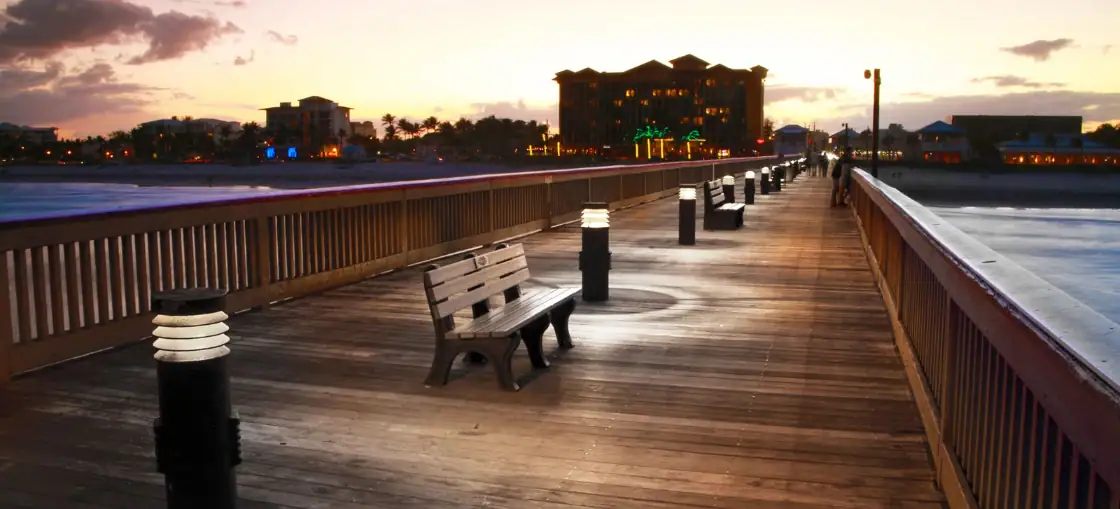
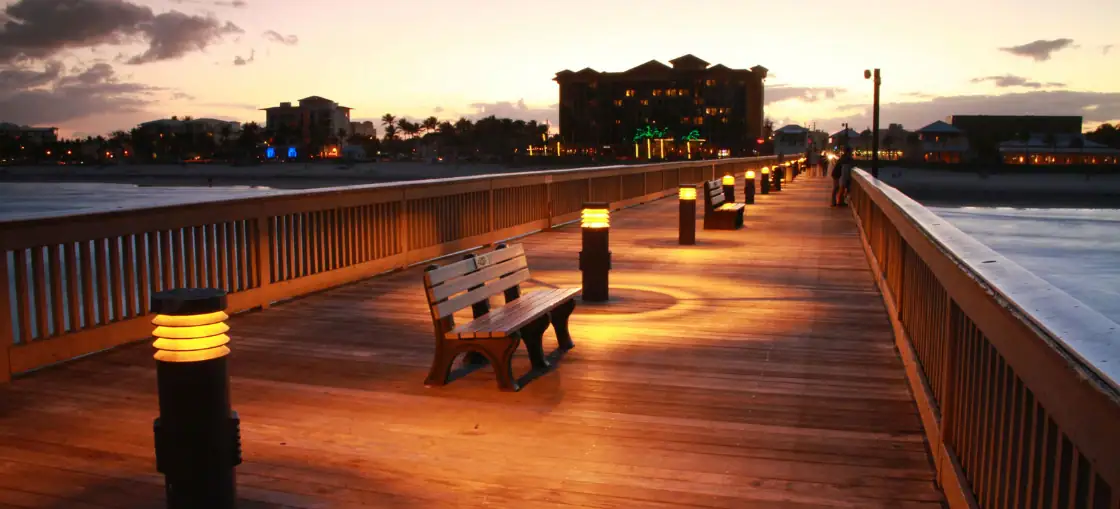
Check out the slider below to see the difference amber lighting makes.

Credit: Acuity Brands Lighting
Watch Out for False Claims
Many products are marketed as “dark-sky friendly” without independent verification. Only products listed in the official DarkSky Approved directory meet the full standard for compliance., so make sure to check the official list before you buy.
What You Can Do at Home or at Your Business
Flagstaff shows that widespread but simple at-home swaps can be effective.
Start by choosing lights rated below 2,200K, ideally narrowband amber LEDs. You can search for these by looking for “turtle friendly” lighting, then ensure you select the option with narrowband amber. Then, tuck fixtures under soffits or eaves so light falls downward, and avoid uplighting and exposed bulbs. Timers and motion sensors can also help you ensure lights are not burning all night. For a detailed breakdown of practical upgrades, review our dark sky home lighting tips.
You can check the impact of your lighting installation with diffraction grating glasses. They let you see any fixture’s spectral output with your own eyes.
How Often Do You Actually Use Those Lights?
Ask yourself honestly: how often does your outdoor lighting serve a real purpose versus running on autopilot? Motion-sensor lighting is a more effective security deterrent than static lighting, and it uses far less energy.
Lights burning from dusk to dawn over empty driveways and vacant lots do not promote safety and can attract criminals.
Final Thoughts
Every light changed to amber, every fixture properly shielded, every timer installed is a concrete step toward a darker, healthier night. Conduct a light audit of your property, then start switching for better choices, one fixture at a time.
Bring these changes wider by sharing this information (and cause!) with your HOA, city council representative, or business association – and join DarkSky Texas for support in your advocacy.
If you are ready to take the next step, join us in protecting Texas nights, contact us to collaborate with your community or business, or support this work with a donation to help advance responsible outdoor lighting across the state.