
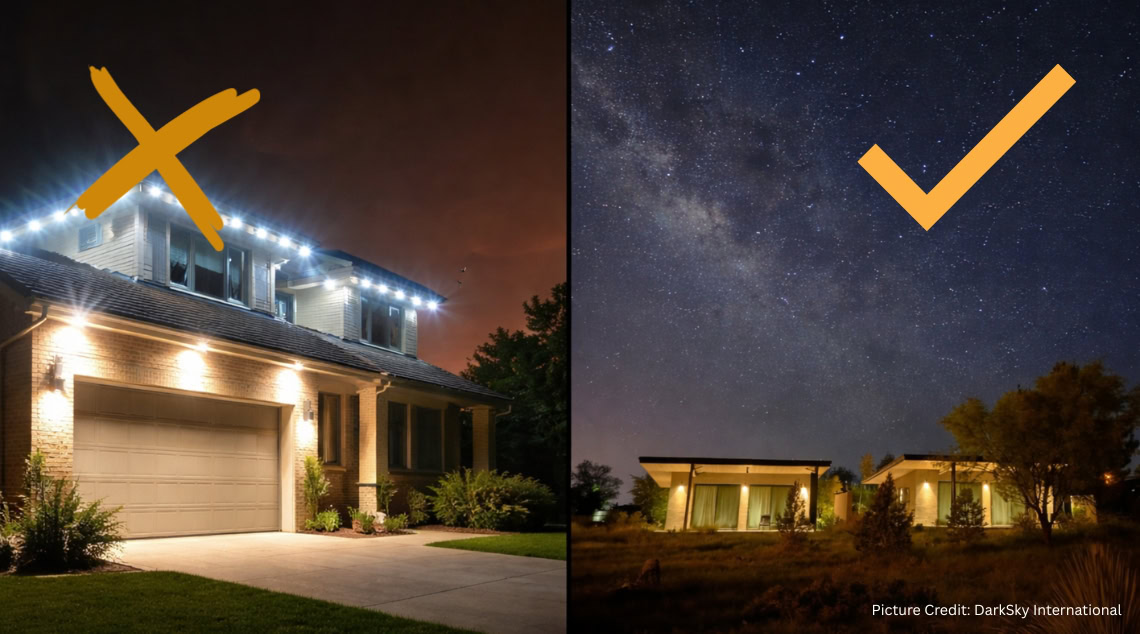
Permanent lights are a growing trend among many homeowners. Permanent lighting installations are year-round LED strips and accent lights installed under eaves, on porches, and around trees that give you full control over lighting your house for every holiday and special event. These lights are offered as an easy way to add ambiance and enhance your curb appeal.
But before you leave your roofline glowing all night, it is worth asking: are these lights helping or hurting our night skies, our wildlife, our landscaping, and our own health? If you have ever wondered how artificial lighting contributes to the loss of our night sky and damage to living things, it helps to understand how to reduce light pollution and preserve our night skies.
What Makes Lighting DarkSky Friendly?
The International DarkSky Association defines responsible outdoor lighting through five core principles. Good lighting should be:
- Useful, serving a clear purpose
- Targeted, directed only where needed
- Low-level, and only as bright as necessary
- Controlled with timers or motion sensors
- Warm-colored, in amber or warmer tones under 3000K.
These are not vague suggestions, but a clear standard. If you want your lights to truly deserve the “Dark Sky-friendly” moniker, they need to meet all five principles. You can explore these in more detail through the five principles of responsible outdoor lighting.
Where Permanent Lighting Installations Go Wrong
Even when installed “correctly,” many permanent lighting installations fail on multiple fronts.
The most common mistake is that they’re visible and unshielded. Lights mounted under eaves can shine sideways into neighbors’ yards or upward into the sky. A good rule of thumb: if you can see the LED bulb or strip from any angle other than below, unshielded light is escaping into the sky or trespassing next door.
Color temperature is another major issue. Many popular systems default to cool white or blue-tinted light, often 4000K or higher. These wavelengths scatter most in the atmosphere and have a greater impact on human and animal circadian rhythms. Warm amber or orange light (under 2700K) is significantly less harmful.
Then there is the “always on” problem. Many homeowners install these lights and simply leave them running from dusk to dawn, every night of the year.
How to Install DarkSky Approved Permanent Lights
If you have a permanent lighting system or are considering one, here’s how to align it with DarkSky principles:
- Use fully shielded fixtures where the light source is completely hidden from side and above views.
- Mount your lights deep under soffits or eaves, so the beam points downward only.
- Choose amber, orange, or red LED bulbs or fairy lights, rather than white ones.
- Add a timer to your system: Timers are now inexpensive and can easily connect to your phone, so you can have your lights automatically turn off by 10 PM.
Want to see the difference for yourself? Try a pair of diffraction grating glasses: they reveal the true color spectrum of any light source and can be a real eye-opener.
These small adjustments may seem simple, but they align with broader efforts to reduce light pollution and protect our night environment.
Beware of Greenwashing
Not every company claiming to be “dark-sky friendly” has done the work to back it up.
The official DarkSky Approved certification ensures that your product has undergone a rigorous review process administered by the International DarkSky Association.
Simply look up your chosen brand in the official DarkSky Approved database. If it’s not listed, then the “Sky Friendly” slogan may be just marketing, not science.
Ask Yourself: Do I Really Need These Lights?
This is the most important question. Before reaching for the remote to light up your home tonight, pause and consider: What is this light for? Is there a real purpose to light up my house right now?
And what happens if you turn them off? Will that make a difference for your neighborhood, for pollinators, for migrating birds, and for the people around you?
You don’t have to give up your lights entirely. Just please be intentional about them.
Take Action to Protect the Night Sky
Start with a lighting audit of your own property: walk around after dark, identify every light that’s on, and ask whether it needs to be. If you’re planning to upgrade your home, business, or neighborhood, seek out and support DarkSky Approved Vendors.
And most importantly, spread the word! Share this post and our list with your neighbors and HOA. Get more people to take the DarkSky Texas pledge and commit to responsible lighting practices in your community.
The stars are still up there. Let’s make it easy to see them again.