
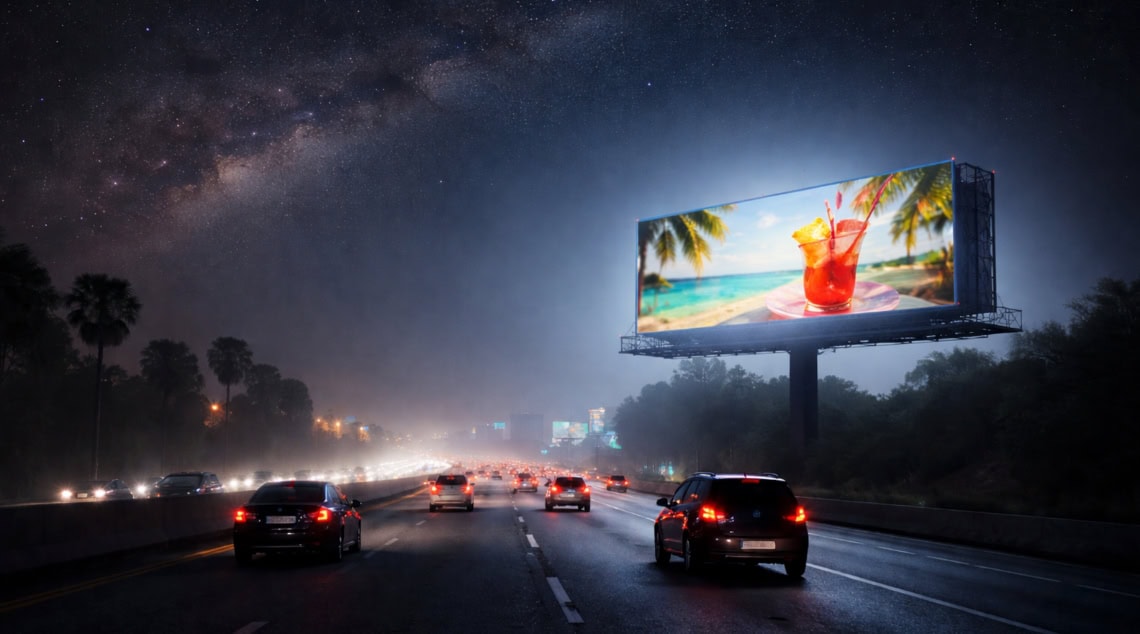
When we think about light pollution, streetlights usually take the blame. But research reveals a different story: billboards and advertising lights are major contributors to the vanishing of our night skies, with serious consequences for wildlife, human health, and our climate.
To understand what practical action looks like, explore how to reduce light pollution and preserve our Texas night skies.
What Are Sky Billboards?
Sky billboards are large-scale, digital, illuminated advertising displays. Unlike traditional static billboards, digital screens use LED technology to display rotating advertisements, creating intense bursts of artificial light visible from miles away.
Brightly lit and often positioned high off the ground, they now dominate highways and urban areas, where they cast light into the atmosphere all night long.
Why Billboard Lighting Is a Problem
Contrary to popular belief, streetlights aren’t the main source of urban light pollution. A 2021 German study led by Dr. Christopher Kyba found that public streetlamps represent only 10-13% of contaminating light sources. Instead, nearly half comes from mounted lighting and billboards.
Why? Because even if most streetlamps are shielded, up to 58% of floodlights and 29% of building-mounted billboard lights are not, casting light skyward and adding to overall light pollution.
The impact is dramatic. In Hong Kong, one of the world’s most light-polluted cities, researchers recorded a 50% darkening of the sky during Earth Hour simply by switching off around 120 decorative and advertising lights on buildings. These few lights, though small in number, were the primary contributors to skyglow in the area.
This issue has significantly worsened over the past decade, as the industry has embraced LED technology for its outdoor installations. LEDs require less energy, allowing companies to install even brighter ads at a lower cost. Moreover, they usually emit harsh, blue-rich white light, which travels farther than warmer yellow light.
The problem is accelerating, and so is its impact on wildlife and human health. These bright blue lights disrupt sleep, increase the risk of cardiovascular disease, and confuse migrating birds.
The Economic Costs
The energy waste is staggering. A single digital billboard can consume as much electricity as 37 homes. In the U.S., light pollution from wasted energy amounts to nearly $7 billion annually.
Unlike street lighting, which serves safety functions, advertising screens exist solely to sell products, making their environmental impact indefensible. Often, that wasted energy eats into profits while impairing the quality of life for nearby residents.
Ecological and Human Impact
Artificial Light at Night (ALAN) disrupts natural behaviors across countless species. Billboard lights frequently shine upward, dispersing into the atmosphere and creating skyglow that tints the night with a gray-blue hue.
Skyglow has been proven harmful to wildlife around the world, with insects suffering effects on mating, feeding, navigation, and development. Migratory birds are thrown off course, their breeding cycles disrupted, leading to declining populations. Bats face a double threat: light prevents them from emerging to feed at optimal times while attracting their prey to illuminated areas they avoid.
For humans, chronic exposure to ALAN has been linked to disrupted sleep, stress, heart disease, and increased risk of certain cancers. Blue-rich LED light suppresses melatonin production, causing sleep disorders, headaches, worker fatigue, and anxiety. The effects extend beyond people, as artificial lighting also disrupts dogs’ sleep cycles and nighttime behavior.
Digital billboards also create glare that reduces visual contrast, making it harder for drivers to see pedestrians and cyclists. This is particularly problematic for aging eyes. These advertisements are designed to distract, creating obvious road safety concerns.
Why It Matters in Texas
With its vast plains, Texas has enormous astrotourism potential. Many Texas communities have seen their economies boosted because they offer a rare glimpse of the skies of decades past, a privilege that is becoming increasingly rare.
Unfortunately, billboard light pollution threatens this nascent economy. The state faces more billboards per mile of highway than many regions, but industry lobbying has made it difficult to pass lighting regulations. Furthermore, many Texas cities are surrounded by expanding rural and suburban development that encroaches on the remaining dark sky areas.
What Can Be Done?
Solutions exist. The first step is to get communities on board, enabling regular families to implement simple yet powerful changes on their own properties. This will provide invaluable proof of the impact of responsible lighting principles, which also apply to commercial fixtures: illuminate only where necessary, use downward-shielded fixtures, install motion sensors or timers, and reduce decorative lighting. These steps align directly with the 5 Principles of Responsible Outdoor Lighting, which provide a science-based framework for reducing glare and skyglow.
At the same time, we need to find common ground with the industry. Lighting ordinances can keep new LED billboards from appearing and promote the return of static signs. Organizations like Scenic America and Adfree Cities are campaigning for responsible advertising guidelines. Local governments and businesses can both play a role in making them mainstream!
While billboard regulation requires policy changes, individuals can still reduce local glare by following practical dark sky home lighting tips.
Final Thoughts
Billboard light pollution is a real environmental threat that cities must start treating as one. As 66% of Americans can no longer see the Milky Way, we face a choice: continue to wrap ourselves in a luminous fog or reclaim our night skies.
Ready to make a difference? Join DarkSky Texas in protecting our night skies. Donate, volunteer, or take the pledge to reduce light pollution in your community. Together, we can turn off the billboards and turn on the stars.