
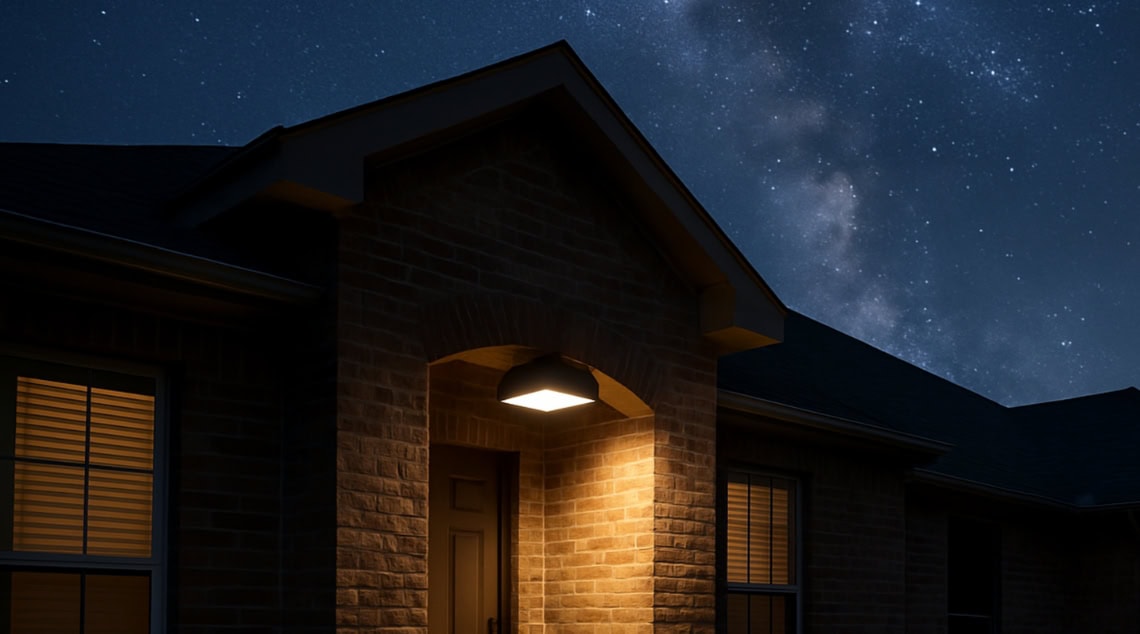
Protecting the night sky is not expensive. Small, low-cost changes at home or in the workplace can make a significant difference and actually save money by reducing the amount of light required to only light the area where light is needed. You don’t have to overhaul your entire property: With just a few simple tweaks, you can transform your lighting from sky-polluting to star-friendly.
So, what exactly is dark-sky-friendly lighting? It’s outdoor lighting designed to minimize glare, reduce light trespass onto neighboring properties, and prevent light from shining upward into the night sky.
When we over-light, direct light upwards, or use the wrong color of light, we disrupt wildlife patterns, impact human health, and block our view of the universe. The good news? Fixing light pollution is one of the easiest environmental problems to solve. Let’s take a look at 6 affordable and straightforward ways in which you can reduce light pollution without giving up your lights!
1. Switch to Fully Shielded Fixtures
Here’s the biggest game-changer: replace those bare bulbs, globe lights, and unshielded fixtures with fully shielded fixtures. These are designed so that no part of the light source is visible from another property nor above the horizontal plane. They aim light downward at an angle, exactly where you need the light, rather than outward and upward.
Shielded, targeted fixtures are especially important. Light shining just 10 degrees below the horizon can degrade the night sky for over a kilometer and impair night vision up to 100 meters away.
Need a pre-approved solution? The DarkSky Approved Luminaires program makes finding the right fixtures easy. Developed by lighting engineers in collaboration with wildlife biologists and health experts, this program provides objective, third-party approval for fixtures that minimize light pollution while maintaining safety and functionality. They include solutions suitable for residential, commercial, and pedestrian uses. Look for the DarkSky Approved seal: it’s the trusted industry standard for responsible outdoor lighting.
2. Aim Lights Downward, Not Outward or Upward
Before placing an order for new fixtures, take a walk around your property at night. Are your fixtures letting light escape into the sky? Shining into your neighbor’s windows? You’d be surprised how many lights are aimed in completely useless directions.
The fix is often as simple as adjusting the angle of your current lamps, without needing to buy anything extra. Tilt floodlights downward, keeping the light source hidden, so they illuminate the ground, not the clouds or neighbors. For poles or lamps that do not allow the angle to be adjusted; consider adding an inexpensive shield or visor to redirect the light (or even a zircon filter, which can help tone down and beautify any escaping light rays). The Night Sky Defenders website offers a quick guide on how they work!
3. Use Lower-Wattage Bulbs
Many of us assume that more light means more safety, but that’s not always the case. Over-lighting is one of the most common lighting mistakes, and it’s not just costing you money. It also creates glare, which often causes more accidents than it prevents.
Here’s the truth: you don’t need that 100-watt bulb. In many areas, 60 watts or 40 watts or even lower wattages can be sufficient to allow you to navigate safely. You’ll be amazed at how much less light you actually need once you eliminate glare and direct light properly. A well-aimed 40-watt bulb in a shielded fixture often provides better visibility than a 100-watt bulb in a globe fixture, which scatters light in all directions.
4. Add Motion Sensors, Timers, or Dimmers
Do your outdoor lights really need to blaze all night long? Probably not. This is where affordable technology becomes your best friend. The “Controlled” principle of responsible outdoor lighting reminds us to shut off lights when not in use. And now, the Smart Home revolution has placed many high-tech gadgets within a normal family’s budget.
Motion sensors are perfect for security lighting: they illuminate when someone approaches, startling most marauders, and turn off when they’re not needed. Meanwhile, plug-in timers can automatically shut off lights after you’re asleep and they’re serving no purpose. Dimmers allow you to adjust the intensity during late hours, reducing glare while still providing some ambient light.
These controls can also lead to significant savings on your electricity bill. It’s a win-win that pays for itself within months.
5. Choose Warm-Colored Bulbs
If your outdoor lights use harsh, blue-white bulbs, it’s time for a change. Blue-spectrum light (anything with a color temperature above 2700K) is terrible for the night sky. It scatters through the atmosphere more than warm light, creating more glare and disrupting both human circadian rhythms and wildlife patterns.
Can’t replace your existing fixtures? There’s an inexpensive fix for that, too. Warm amber filters, designed for movie sets and stages, can be applied to overly blue fixtures to correct the color temperature. Cities have successfully utilized these filters to retrofit high-temperature parking lot lights, thereby significantly reducing glare and blue light emissions.
6. Learn from Local Success Stories
You’re not alone in this effort. Right here in Texas, places like Big Bend Dark Sky Reserve have shown how practical lighting strategies can preserve stunning night skies while maintaining safety and functionality.
Big Bend’s success comes from enforcing simple guidelines that anyone can follow. The results speak for themselves: spectacular starry skies, reduced energy costs, and thriving nocturnal wildlife. What’s more, as they already did some of the legwork, you can now learn from their experience and jump straight to proven solutions.
How Can You Get Action Rolling?
Here’s the bottom line: simple, low-effort steps can protect night skies, improve visibility, save money, and help wildlife. You don’t need to change everything overnight. Start with one improvement this week. Replace that glaring front porch light with a shielded fixture. Swap out a blue-white bulb for a warm amber one. Install a motion sensor on your garage lights.
Then keep going. Talk to your neighbors about what you’ve learned. Encourage local businesses to make similar changes: many would be happy to reduce their electricity bills while being good environmental stewards.
Check out the resources on our website and make your commitment public by taking the DarkSky Pledge. Then keep going. Share what you’ve learned with your neighbors, and join us in protecting Texas skies by becoming part of our growing community. If you can afford it, consider donating to help us spread these actions to more towns.
The stars are waiting. Let’s bring them back, one light at a time.