
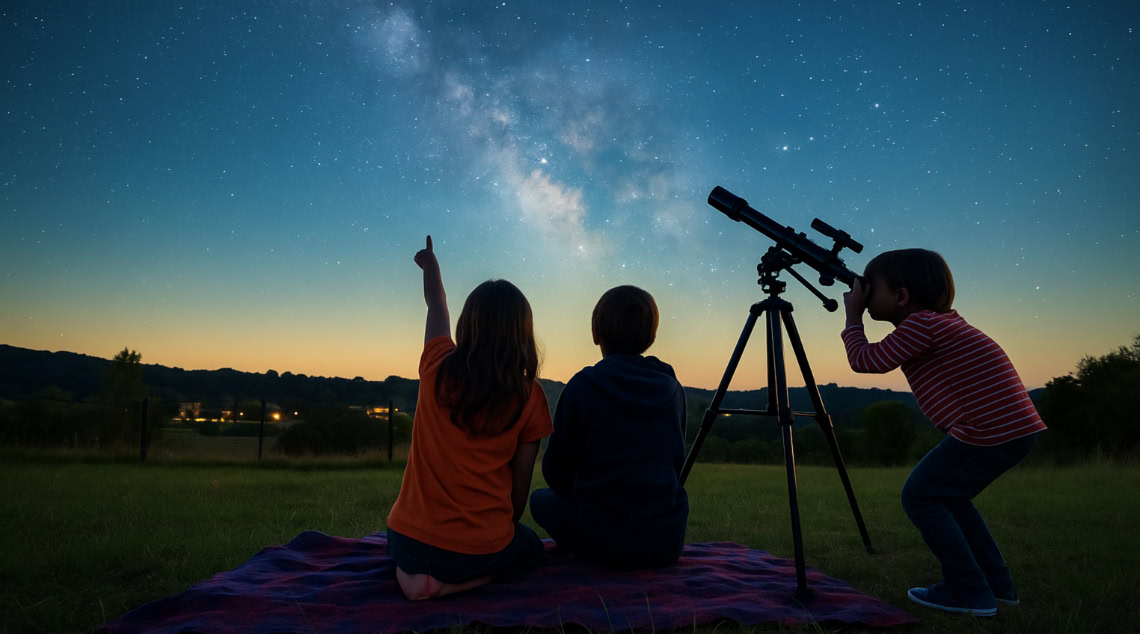
Remember the last time you looked up at a truly dark sky, filled with thousands of twinkling stars? That sense of wonder is what we’re fighting to preserve for every child in Texas.
After all, dark skies matter because when artificial lights wash out the stars, we disrupt entire ecosystems. Migrating birds lose their way, fireflies can’t find mates, sea turtles can’t find the ocean, and our own health suffers as bright lights interfere with natural sleep cycles.
Here’s the exciting part: children can be the heroes of this story. The first step is to understand what you’re saving and why it matters. Then, you can start inspiring the entire community around you.
4 Ways to Take a Stand for the Night Sky
In a world made by and for adults, it can be hard to spot where young people can make a difference. Every young person has the power to become a guardian of the stars, protecting this cosmic inheritance for future generations.
Here are 5 ways to be the star your local skies need!
1. Organize Interactive Stargazing Events
Nothing beats experiencing the magic firsthand! Hosting local stargazing nights will instantly turn you from a passive observer to a key player.
Start simple: organize an evening at your local park, school playground, or backyard. Contact nearby observatories or astronomy clubs: many may have telescopes and volunteers eager to help. Time events around a new moon for darkest skies, and bring red flashlights to preserve night vision. Offer red cellophane and rubber bands to cover attendee’s flashlights.
Pro tip: keep things interesting with a constellation scavenger hunt, to keep everyone looking for the Big Dipper, Orion, or Cassiopeia. You can also have someone share stories behind star patterns, such as Greek myths, Native American legends, or space discoveries. A demo of shielded lighting with true amber bulbs is a great way to talk about better outdoor lighting.
2. Tweak Your At-Home Routine and Earn the Be A Star Award
Small home actions create big community changes. Transform your family’s lighting habits into a fun project that children can lead.
Begin with a “light audit” and examine your home through the eyes of a detective. Identify unnecessary outdoor lights. Are porch lights blazing all night? Is light streaming from uncovered windows? Take charge of the family’s nightly “lights out” routine.
If you need a quick blueprint to get started, use the 5 Principles of Responsible Outdoor Lighting as a roadmap. Simply check that any of your lights visible from outside are:
- Useful: Only light where needed.
- Targeted: That means, pointing downward rather than spreading outwards.
- Only as bright as they need to be.
- Controlled: Connected to motion sensors or timers.
- Warm-Colored: Yellow-toned bulbs are less disruptive than blue-white ones.
Your home can earn the Be A Star Award when your lights follow these five principles.
Finally, make closing curtains part of the bedtime routine. This keeps rooms dark for better sleep while preventing indoor light from spilling outside.
3. Become a Local Advocate
Kids have superpowers adults sometimes forget: boundless enthusiasm, genuine curiosity, and the ability to ask “why?” until they get honest answers. Channel these qualities into advocacy that creates lasting change.
You can do this through:
- Letter-writing campaigns: write a passionate appeal for dark skies to your local representative.
- A themed science fair project: measure light pollution in your areas, document how artificial light affects local wildlife, or test which lighting types cause the least sky glow. You’ll be inspiring your classmates while working towards a top grade!
- Ask your schools or Scout troops to visit the local planetarium.
4. Get Artistic
Art and storytelling can connect hearts in ways facts alone cannot. Through creative expression, you can inspire others to care about night skies as well.
It can be as simple as writing stories about adventures under starry skies – tales of young astronomers discovering constellations, or heroes who save wildlife by fixing harmful lights. Poetry can capture the beauty of a dark sky or express sadness about losing stars to light pollution.
If drawing comes more easily, you can use visual arts to make abstract concepts concrete. Photography projects comparing urban and rural night skies help document the problem. And if you are willing to take it a step further, consider creating a short documentary about local light pollution or stop-motion animations that show how light affects migrating birds.
5. Fight for the Stars: Be a Knight for the Night
If you’re looking for a way to engage children while teaching them about light pollution, the Fight for the Stars: Be a Knight for the Night program is an excellent starting point. This hands-on initiative combines online and outdoor activities to help kids become passionate protectors of the night sky.
The program offers complete lesson plans tailored to different grade levels, covering everything from why reducing light pollution is important to their lives to night sky observations. It encourages children to develop critical thinking, environmental awareness, and leadership skills.
All resources are available for free and can be used by parents, teachers, or volunteers.
Children who complete the program can even earn fun patches like the Dark Sky Patch and Midnight Defender Patch, making the experience both educational and rewarding.
Are You Ready to Take the Pledge?
Every star guardian needs a mission statement, and the DarkSky Texas Pledge provides precisely that. This commitment goes beyond good intentions: it’s a concrete promise that children and families can make together.
Make taking the pledge a family celebration. Read it together, discuss what each commitment means, and let children suggest additional promises your family wants to make. Some families create their own “star guardian certificates” to display proudly, while others plan special stargazing trips to celebrate their commitment.
Of course, taking the pledge is just the beginning. Talk to your family and see if you can support DarkSky Texas through donations, volunteering, or by officially joining our mission to protect the night sky with advocacy efforts and community outreach.
The stars have waited billions of years for a new generation of defenders. With young guardians leading the charge, Texas can become a beacon of hope, proving that communities can grow and thrive while keeping their connection to the cosmos.