
Why Light Pollution Needs Monitoring
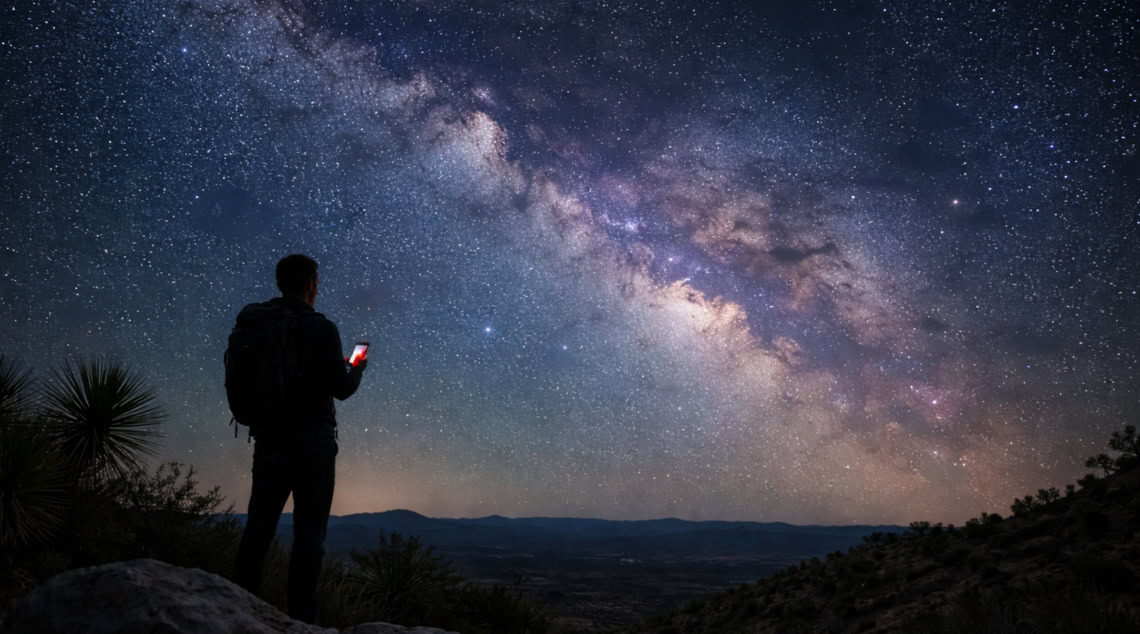
When was the last time you looked up and saw the Milky Way stretching across the Texas sky? For many of us, that experience has become increasingly rare, as light pollution (the intrusive glow of artificial outdoor lighting) is washing out our night skies.
Excessive lighting disrupts ecosystems, affects human health (including pets) wastes energy, and threatens our right to experience natural darkness. To understand the scale of this problem, we need coordinated community action. Measuring sky brightness is only the first step. We must also learn how to reduce light pollution and preserve our Texas night skies through practical action.
Globe at Night offers an accessible, science-backed way to join this effort. You don’t need any expensive equipment or an astronomy degree! Your eyes, a smartphone, and a few minutes are enough to help.
What is Globe at Night?
Globe at Night is an international citizen science campaign designed to raise public awareness about light pollution while gathering critical data on night sky brightness. NOIRLab, the preeminent U.S. national center for ground-based nighttime optical and infrared astronomy, operates it.
Since its 2006 inception, Globe at Night has received more than 200,000 measurements from over 180 countries. Scientists can use this data to track light pollution trends over time. It allows us to compare conditions across different regions and their effects on local wildlife. For astronomical researchers, it helps them preempt possible interference in their projects.
Why Measure with Your Eyes?
In an age of sophisticated technology, you might wonder why visual observations still matter.
The beauty of Globe at Night lies precisely in its accessibility: You don’t need to purchase a Sky Quality Meter or any specialized equipment. Your eyes, adapted to darkness, are remarkably sensitive instruments capable of detecting differences in sky brightness that directly correlate with light pollution levels.
This simple and almost completely free contribution democratizes science and puts it within reach of families, students, and hobbyists alike. And every observation submitted strengthens the global dataset!
How to Participate in Globe at Night
Measuring nocturnal light levels is remarkably easy. But just like any other scientific endeavor, it’s best to approach it systematically.
The first step to get a good measurement is to find the right time: a night when the moon is not up, more than one hour after sunset. The Globe at Night website provides the dates when readings should be taken. Then, locate your favorite constellation of the season (or look for the latest Globe at Night campaign to see this month’s highlighted constellation).
You will need to let your eyes adjust for at least 10 minutes before observing anything. During this time, avoid looking at phones or any bright lights. Once you’re ready to locate your target constellation, compare what you see with Globe at Night’s sky charts, and take note of which one is the faintest star you can detect.
Finally, go to the Globe at Night website or use their web app to submit your reading. If you use your smartphone, it will automatically capture date, time, and location coordinates.
Tips for Accurate Observations
The first time you try observing the night sky may be confusing. Here are some tips that will help you detect starlight more easily.
First, remember that location matters, so try to position yourself away from direct lights. If you need to consult star charts, write notes, or check the Globe at Night instructions, use a red or amber LED flashlight rather than white light. Finally, consider making multiple observations from different locations over the course of a single campaign.
Why Observation Matters in Texas
Texas presents a unique opportunity for light pollution monitoring. Our state encompasses everything from major metropolitan areas to some of the darkest rural skies remaining in the country.
By helping organizations like DarkSky Texas in their advocacy efforts, you will be strengthening their case for implementing better outdoor lighting standards. These standards are rooted in the 5 Principles of Responsible Outdoor Lighting, which guide communities toward useful, targeted, low-level, controlled, and warm-colored lighting.
Extra Resources and Library Kits
If you want to deepen your engagement with light pollution monitoring, consider exploring the citizen science kits available through participating public libraries.
These kits, accessible through SciStarter, often include tools like Sky Quality Meters, planispheres, red LED flashlights, and detailed instructions for conducting observations. If your observation reveals heavy skyglow in your neighborhood, consider reviewing practical dark sky home lighting tips to improve conditions locally.
They’re an excellent resource for school groups and scout troops, too: they provide everything needed for successful sky brightness monitoring.
Final Thoughts: Be a Night Sky Guardian
One observation might seem small, but that’s exactly how powerful datasets are built. Texas participants have a special role to play in this movement. Our state’s size and diversity mean that we can provide crucial data about how light pollution behaves across different environments and climates.
Eager to get started? Visit Globe at Night to start observing tonight. When you are ready to take a step up, get a Sky Quality Meter and share your observations with DarkSky Texas. You could also encourage your local school or library to distribute Globe at Night Kits.
Every night, the stars over Texas are getting dimmer, but most communities don’t even realize it’s happening. DarkSky Texas is building a statewide network to measure and protect our night skies. Each Sky Quality Meter captures real data that helps communities understand light pollution, shape smarter policies, and preserve the stars for future generations. A gift of $1,000 fully supports one continuous-read monitoring station for an entire year, from equipment and installation to ongoing monitoring, maintenance, and data reporting – collecting insights every night and turning them into action across Texas.
Ready to take that next step? Join us in protecting the Texas night sky, contact us to collaborate with your school, neighborhood, or city, or support this work with a donation to help expand light pollution monitoring and advocacy across the state.