
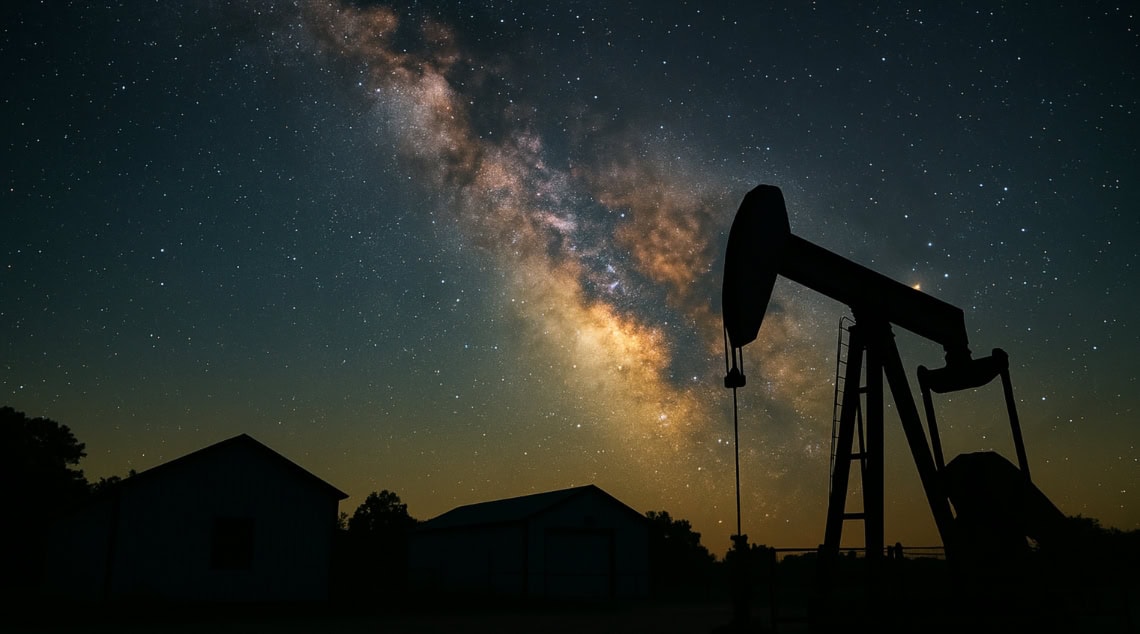
At the start of 2025, DarkSky International recognized three oil and gas facilities in New Mexico as “Night-Sky Friendly”. This is the first-ever achievement: known by their bright floodlights, flames, and industrial architecture, no energy facility had ever been DarkSky Certified.
What’s more, this is happening right next door in the Permian Basin, the world’s largest land oil reserve, which spans Western Texas and Southeastern New Mexico, echoing how Texas communities are battling light pollution on many fronts. Over the past few decades, this area has progressively lost the magical night skies it was once known for. Thanks to the joint work by DarkSky International, the Dark for the Park Alliance, and the Franklin Mountain Energy company, we now have a method and a blueprint ready to bring the Texas energy industry on board.
A Radical Development for Researchers
At DarkSky Texas, we passionately believe that the night sky is everybody’s heritage. However, it is undeniable that this certification could be a game-changer for local astronomers, especially as more facilities embrace the movement.
And while we would love to see more DarkSky-certified locations in Texas, we should remember that those in New Mexico will still affect observatories on our side. According to Stephen Hummel, from the McDonald Observatory, “Light doesn’t stop traveling when it hits the state line.” If the Dark for the Park Alliance manages to bring its initiative to Texas, these benefits will multiply.
How Did This Initiative Come About?
The recent hits are the result of years of work and activism across the American Southwest, where astronomers have watched with concern as the impact of industrial lighting has grown.
Among its first pioneers was Bill Wren, a leader at the McDonald Observatory. Over 10 years ago, he, with support from members of DarkSky Texas, was among the first in Texas to speak out about the normalization of sky glow and to educate the public about the role of industrial lighting.
For him, access to the night sky was pivotal for the next generation of scientists: “Astronomy is intuitively fascinating for people. [..] Especially kids are fascinated by it, and there is a sense of awe created by it.” This is especially relevant given the growth of astrotourism in Texas and the risks when skies go bright.
Following his example, the Texas Astronomical Society of Dallas began monitoring the advance of skyglow in the Permian Basin – and, perhaps more importantly, posting about it. Many of the wells they tracked were 100 miles from Fort Davis, yet their impact was noticeable to both professional and amateur astronomers.
What Is the Media Saying About This?
A big part of spreading an initiative is to get the word out. Here, the media is fortunately chipping in!
Local news station KRQE in Albuquerque recently ran a report on lighting improvements in the region. They provided a good summary of the simple changes made, which included:
- Switching outdoor fixtures to warmer tones, which are less disruptive
- Aiming floodlights downwards, directly at the spots that need the lights
- Reducing the amount of scattered lights by 99%
- Retrofitting two existing stations following the 5 Principles for Responsible Outdoor Lighting
- Building a brand new structure under the same parameters
These measures echo the advocacy seen at events like DarkSky Day at the Texas State Capitol, where policy and industry met under one sky.
Moreover, they stressed that this was made possible by collaboration between conservationists and private industry, which are frequently portrayed as being at odds with each other. Instead, their open dialogue created a win-win situation: skyglow levels have diminished dramatically, and the Franklyn Energy Company even enjoyed a 60% decrease in its own electricity consumption.
Final Thoughts
By getting these three facilities certified, we have kick-started what will be a much more widespread partnership.
It may have all started with a few concerned astronomers, but through public education, awareness initiatives, and open negotiations, we now have a proven success under our belt.
The next step will bring our focus back to Texas. We can embrace this opportunity to bring more local energy companies to implement anti-light pollution initiatives, creating a darker, more marvelous Permian Basin for nature and the people in both states.
For this, we need your help. Your donations to DarkSky Texas will help us energize what was started in New Mexico. Learn more about how your contributions can help. Join us, take the pledge, or sign our volunteer interest form.