
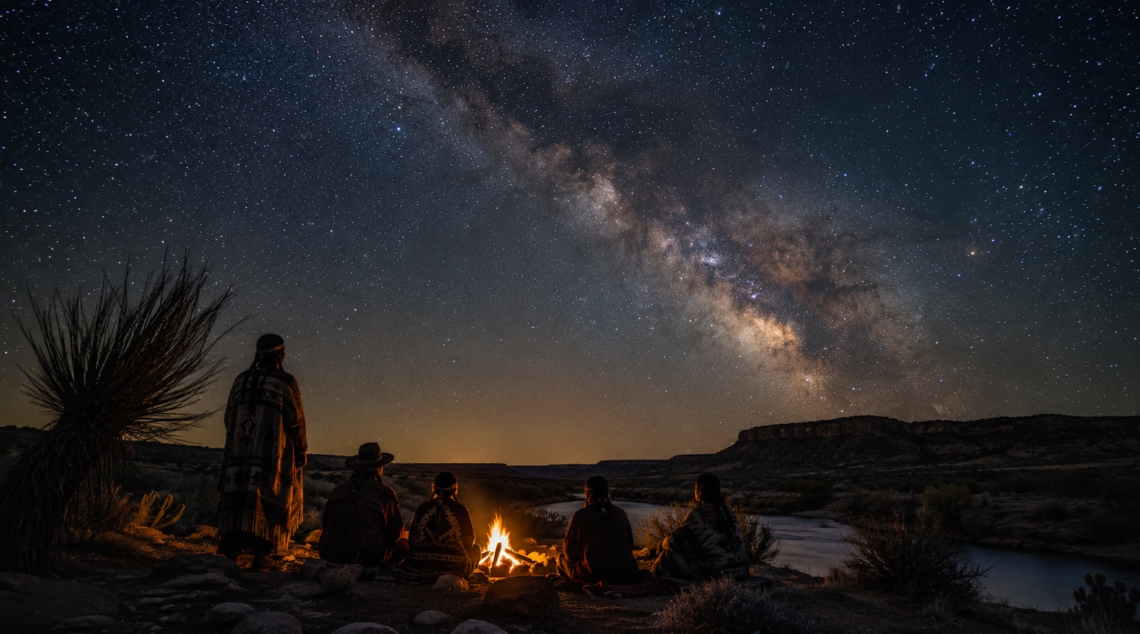
Most of us look up at the night sky and see stars. They are beautiful and a little humbling, but ultimately distant. For generations of Indigenous peoples across Texas and the Americas, that same sky was something far richer: a living map of stories, a calendar, a compass, and a connection to their ancestors.
Today, we explore the human and cultural depth of the night sky.
The Sky as a Storytelling Map
Long before written language, the stars carried knowledge. Indigenous oral traditions used the constellations as the foundation of their origin stories. In this way, their cyclical movements helped preserve knowledge and pass down cultural identity.
There is a practical dimension to this knowledge, too: it marked when to plant, and it guided their movement across vast landscapes.
As Cree astronomer Wilfred Buck explains, in Indigenous traditions, “there is a story for every star and every constellation, and every star has a name and a teaching attached.” These were not just myths. They were living knowledge systems refined over thousands of years of careful observation.
Texas Tribes and Their Connection to the Sky
Tribes with deep roots in Texas, such as the Caddo, Comanche, and Apache, all developed intimate relationships with the night sky that shaped every aspect of daily life.
The Caddo people of East Texas used celestial observation to time agricultural and ceremonial calendars. These were so important to their world vision that their most powerful deity, the Caddi Ayo, was known as the “Captain of the Sky”. The Comanche, known as “Lords of the Plains,” were expert nighttime navigators. By tracking star movements, they could traverse vast stretches of Texas terrain, often mobilizing under cooler night skies.
Stories Written in Stars
Across the Americas, ancient civilizations turned astronomical landmarks into characters.
The Milky Way
Across many Indigenous traditions, the Milky Way is seen as a path, a river, or “The Sky’s great road”, connecting our world with the spirit world. For the Lakota, this Ghost Road marks the path of souls traveling to the afterlife, while the Navajo viewed it as the arms and shoulders of Father Sky. The Cherokee tell a story in which the Milky Way was created by a dog who ran away after stealing cornmeal, dropping the meal from his mouth as he fled to safety.
Constellations With Meaning
When you look at the Pleiades, you might think of the Greek myth of the Seven Sisters. But the Caddo saw seven lazy brothers, who danced and floated into the sky after refusing to do their chores. That is why, in the Caddo tradition, the Pleiades appear only in winter, when there’s no planting work to be done.
Meanwhile, other Caddo elders speak of the Orphan Star, a lonely boy rescued by a lake monster and eventually taken up to the sky by the Evening Star, where he found belonging beside him forever. These are not just charming tales. They carry lessons about courage, community, and what it means to care for those who have been left behind.
Seasonal Sky Changes
Another common pattern is the use of stars to track seasons. Once again, we know the Caddo timed ceremonies and harvests around celestial patterns observed and refined across generations. The sky was a shared clock to all who knew how to read it.
What We Have Lost
Light pollution has done more than wash out the stars. From residential glare to larger sources like billboards and advertising lighting in Texas, artificial light is making it harder for communities to experience truly dark skies. It has severed a thread that ran from the first peoples of this land all the way to us.
When younger generations can no longer see the Milky Way from their backyards, they can no longer imagine the travels of those who came before them, and they do not get the chance to pass those stories on to their own children. Even localized issues like neighbor light trespass in Texas contribute to the gradual disappearance of visible stars from everyday life. This is a deep cultural loss.
As writer David A. Robertson puts it: “The stories are easy to find, as easy to find as the stars.” But only if the stars are there to see.
Why It Still Matters
Preserving the night sky is an act of cultural preservation. It is also part of a larger effort to understand the environmental and business costs of light pollution across Texas communities. The stories embedded in the Texas night sky belong to a human heritage that predates every city, every highway, every streetlight. Reconnecting with them, even if imperfectly, is a way of honoring the people who called this land home long before us.
The sky, as one storyteller put it, “acknowledges and embraces us all.”
Bringing the Stories Back
You do not have to be an astronomer to start. Go outside on a clear night, away from city glow, and simply look up. Seek out dark sky events and community stargazing gatherings. You can even begin starting a dark sky movement in your community to help protect these stories for future generations. Learn about the Indigenous names and stories tied to the constellations above Texas. Listen to those whose traditions these stories belong to. Approach it with curiosity and respect.
The Role of DarkSky Texas
DarkSky Texas works to protect darker skies across the state, preserving them for everyone. We support education and awareness initiatives that engage communities and reconnect them with the night sky. If you want to become part of this effort, you can join us in protecting Texas night skies. We want to connect with scientists, photographers, and anyone who wants to stand under a sky full of stars.
As long as the stars are still there, we will have something to protect.
A Final Thought
The stars above Texas tonight are the same ones the Caddo watched for planting season, which carried stories of orphan boys, lazy brothers, and warriors turned to light.
They are waiting to be seen again, waiting for us to take action.
How? Reduce unnecessary outdoor lighting at your home. Support dark sky policies in your community. Find a dark spot, look up, and let the sky remind you that you are part of something much older and much larger than yourself. Then share what you find. You can also support this work directly by donating to DarkSky Texas and helping expand education, advocacy, and night sky protection efforts across the state.